
Photo courtesy of the AMOY Working Group
Monitoring
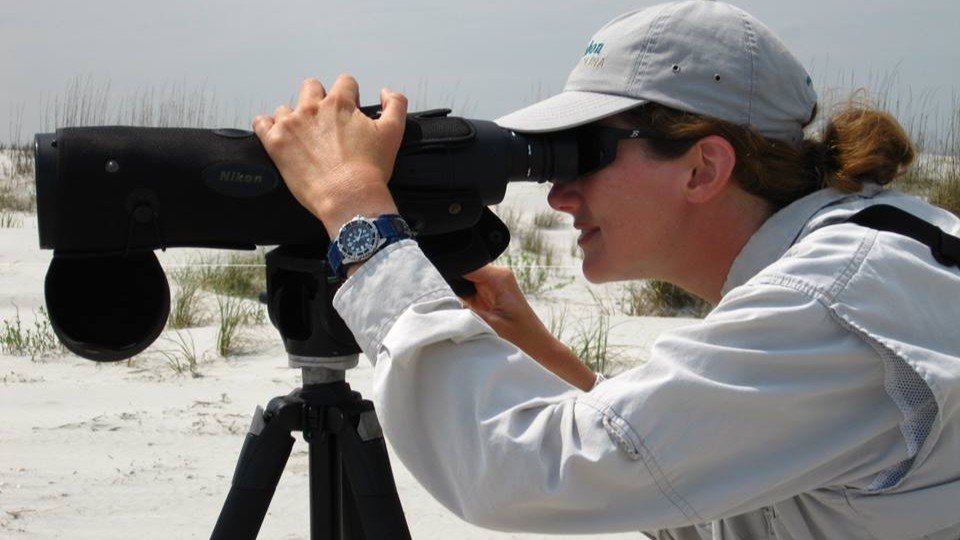
Monitoring is the repeated observation and measurement of specific metrics over time. It allows us to determine the status of resources under our stewardship (in this case, American Oystercatchers) and to evaluate whether or not our management is effective or it needs to be adjusted.
Oystercatcher monitoring has focused on identifying limiting factors (problems affecting oystercatchers), especially during the breeding season, which has allowed us to develop best practices for protecting them during the nesting season. The Working Group has also implemented range-wide banding and survey work in order to assess demographic trends.
Productivity Monitoring
The goal of productivity monitoring is to determine how many fledgings are produced per pair and understand causes of nest or brood failures. It involves making repeated visits to breeding pairs throughout the breeding season, allowing site managers to identify limiting factors. Findings can then be used to inform management actions. The Working Group developed standardized output metrics in 2010 (with a 2019 update) and collects summary productivity data from all partners who monitor their oystercatchers’ reproductive success. Beginning in 2022 it launched a productivity monitoring protocol to ensure that all inputs, as well as summary data, were consistent. Population modeling found that a 0.55 fledgling/pair rate was needed to sustain and grow the population, and sites that conduct productivity monitoring work to meet or exceed this goal.
Range-wide Aerial Surveys
During the winter months, oystercatchers congregate in large flocks, roosting together at high tide. This makes them relatively easy to count, so to estimate the entire U.S. Atlantic and Gulf coast population, a survey method was developed. A small airplane flies all habitat at high tide, counting and photographing flocks, while observers on the ground count flocks and read bands. Afterward, detection error rates are determined, producing an estimated population size with statistical confidence intervals. These surveys have taken place in 2003, 2008, 2017, and 2023 and are the basis for measuring progress towards the population goal.
Other Counts
Sites or states may conduct other types of surveys to assess numbers of breeding or non-breeding oystercatchers. Examples include various state’s mid-winter shorebird surveys which include oystercatchers, Florida’s Breeding Bird Protocol, and New Jersey’s fall oystercatcher counts, and North Carolina’s American Oystercatcher and Wilson’s Plover census.