
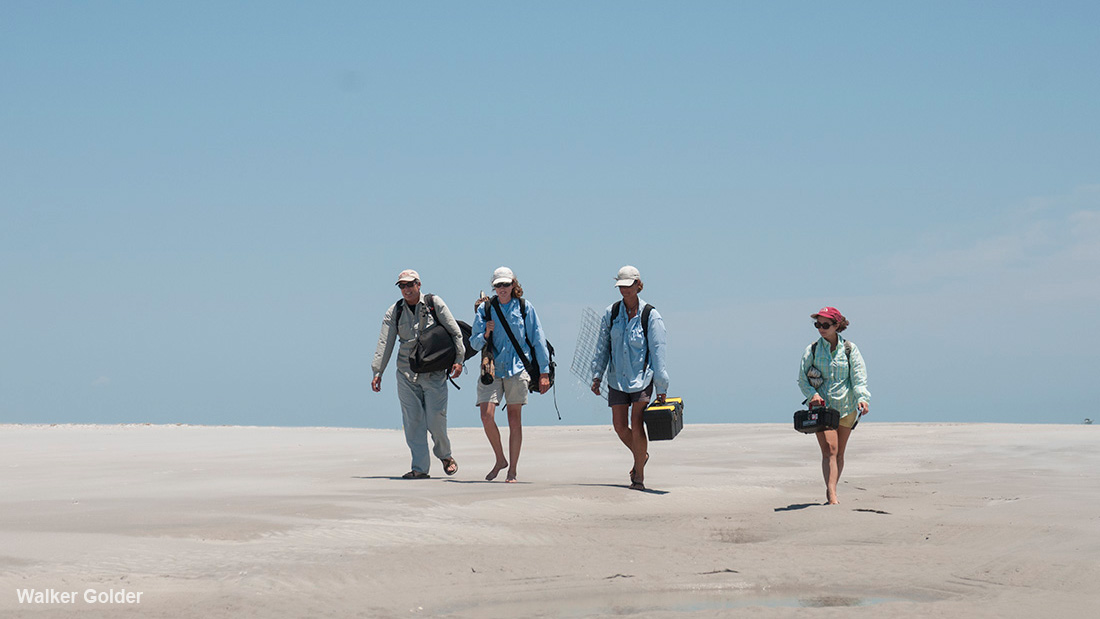
AMOY banding team walking up the beach. Photo by Walker Golder.
Research
Research uses scientific methods to answer specific questions–often, in the case of oystercatchers, related to informing conservation efforts. The results are presented at Working Group and other professional meetings and often published in peer-reviewed scientific journals or as less formal reports. Many of these publications are available in the website’s Resource Library, and many of the presentations that have been made at Working Group meetings are archived on each year’s page.
Banding and Resighting
Across their range, oystercatchers are captured as adults or chicks and given field readable bands in accordance with the Working Group’s coordinated banding scheme. Then, observers–professional field biologists or recreational birdwatchers alike–resight banded individuals, allowing researchers to monitor survivorship, movements, and other demographic parameters. Most states have some form of structured resighting during the non-breeding season. Banding has been a cornerstone of the Working Group’s monitoring work since its foundation.
Tracking
Tracking involves attaching a type of lightweight technology to a bird that allows researchers to follow their movements remotely. Attachment methodologies vary by species, with leg loop harnesses being the safest method for most shorebird species, including oystercatchers. For young chicks that cannot be harnessed because they would grow out of them, tags are glued onto their backs. Early tracking efforts used radio tags to monitor pre-fledged chicks in order to determine causes of mortality. As technology improved and miniaturized, tracking work graduated to deploying units that communicate with the satellite or cellular systems to record locations.
Disturbance and Human Dimensions
Human dimensions includes evaluating the efficacy of methods to educate the public about how to avoid disturbing birds during sensitive parts of their life cycle. Biologists may work with social scientists to understand how to deliver the most effective communications to their audiences. Researchers may also examine what types of activities and distances are the most or the least disturbing to oystercatchers to ensure that human activities do not affect their ability to raise young successfully, roost, and forage.
Foraging and Diet
For a bird with its primary prey item in its name, there has been a good deal of research into what oystercatchers eat and how. Early work in the 1980s looked into rates of food consumption and handling time, as well as chick provisioning rates. Additional recent work has expanded on this theme and delved into the connection between nesting landscape and prey items. Finally, water quality and shellfish health are also linked to the resilience of oystercatcher populations.
Habitat Use
Habitat research may examine what makes a good nesting or roosting site and what can be done to enhance habitat for the benefit of oystercatchers and other coastal birds. Sea level rise is reducing elevation in many optimal habitats so it is important to define what these habitats consist of and whether or not they can be restored or rebuilt.
This is not an exhaustive list of types of oystercatcher research. Browsing the presentations linked to on each annual meeting’s page is a great way to learn about the depth and breadth of oystercatcher science.