
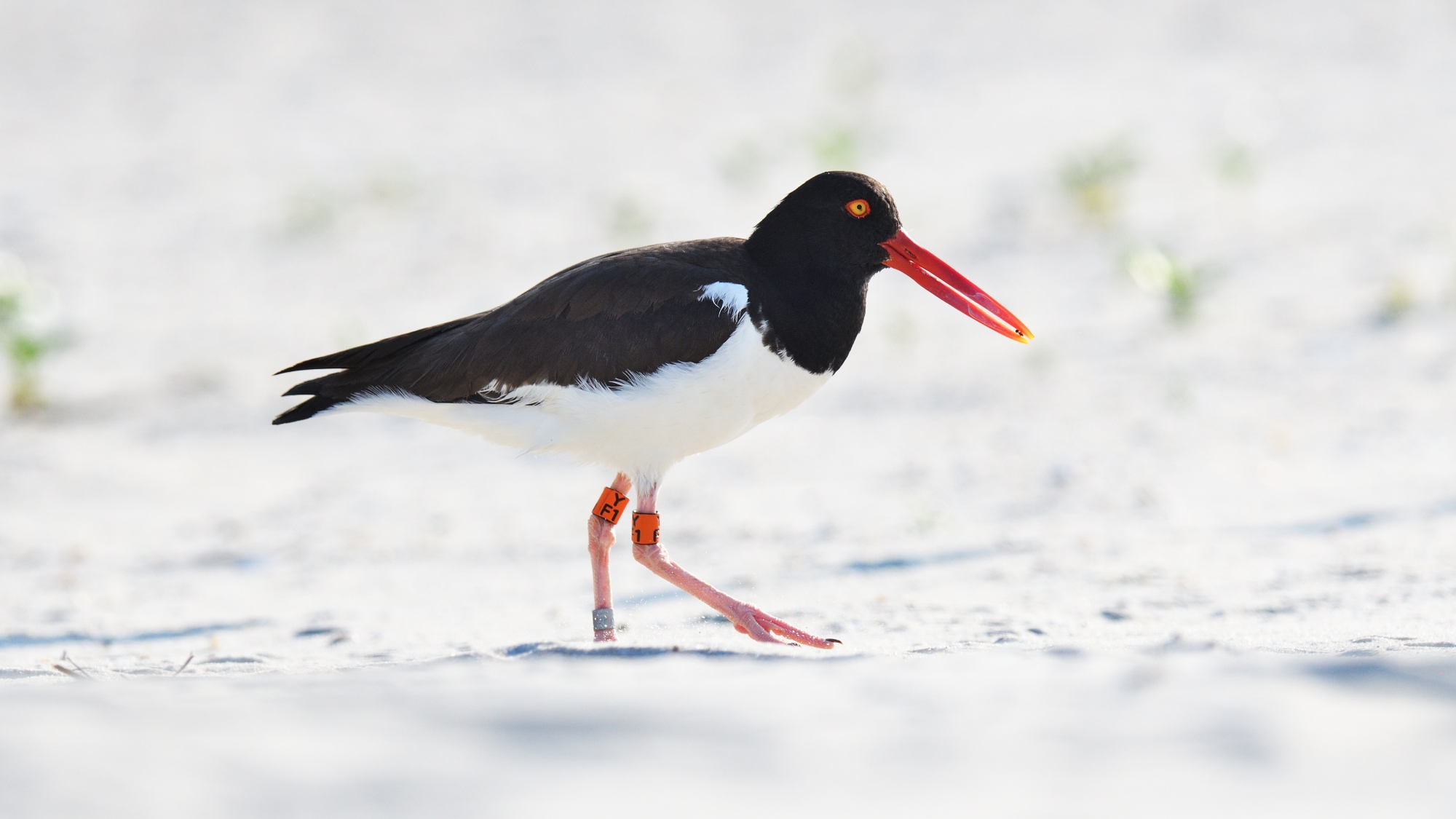
Photo by Terence Zahner
American Oystercatcher Working Group
Mission Statement
The American Oystercatcher Working Group seeks to develop, support, and implement range-wide research and management efforts that promote the conservation of American Oystercatchers and their habitats through individual and partnership-based initiatives guided by recommendations of the Working Group’s membership.
History
On December 19, 2001 a meeting of federal, state, and non-governmental agencies and scientists responsible for managing shorebirds was convened in South Carolina to discuss forming a regional oystercatcher working group to address research and conservation priorities for the species. The group’s first course of action was to obtain a complete population estimate of wintering American Oystercatchers along the U.S. Atlantic and Gulf coasts. This was achieved the following winter through aerial surveys which yielded a range-wide population estimate of 11,000 birds (Brown et al. 2005).
Early meetings focused on sharing information, building relationships among partners, and understanding threats. In 2004, the group standardized the banding scheme and initiated a large-scale cooperative mark-resight study, and in 2007 it developed a position paper and mission statement. With a clear need for coordinated conservation, the Working Group sought and received funding from the National Fish and Wildlife Foundation to launch a range-wide recovery initiative, which continues today.
The aerial surveys are repeated every five years to track progress and from 2008-2023, the U.S. population has increased 45% to an estimated 14,735 birds. The species still faces serious threats, and the Working Group continues to meet annually to continue to advance oystercatcher conservation.
Goals and Objectives
Working Group goals include the development of management objectives in a science-based, adaptive management framework. Primary objectives include
- monitoring population trends at local, regional, and continental scale;
- obtaining reliable estimates of demographic parameters and the factors that affect them;
- understanding how variations in demographic parameters affect population viability over space and time;
- identifying threats to American Oystercatcher populations;
- and translating these findings into management actions that promote American Oystercatcher conservation; promoting best-management practices range-wide; adaptively updating management practices.
Membership and Geographic Range
Working Group members represent a wide range of disciplines and backgrounds from site managers and field biologists, to academics and students, to educators and birders. Members represent nearly all Atlantic and Gulf coast U.S. states. The Working Group’s focus has been on the U.S. breeding population, but recent efforts involve supporting partners in Latin America as well.
Working Group Accomplishments
The Working Group has achieved a number of research, management, and conservation milestones. These accomplishments have stemmed from site-specific, regional, and range-wide projects and have contributed significantly to the overall understanding of oystercatcher ecology. Accomplishments include:
- development of the American Oystercatcher Conservation Plan;
- completion of repeated range-wide winter surveys (Brown et al. 2005);
- establishment of a standardized range-wide banding protocol;
- initiation of re-sighting surveys throughout most of the species’ range, the results of which have greatly clarified our understanding of American Oystercatcher seasonal movements;
- development of a 10-year Business Plan for the conservation of the American Oystercatcher (Brown et al. 2008) supported by the National Fish and Wildlife Foundation;
- establishment of the American Oystercatcher Working Group website;
- production of a revised species account for The Birds of North America;
- creation of the American Oystercatcher Best Management Practices document;
- creation of the American Oystercatcher Band Database;
- Waterbirds 2017 American Oystercatcher Special Issue; and
- creation of the American Oystercatcher Productivity Protocol.